by: Stephanie Zacharek | Time.com
If you’re like most people, your preoccupations in late summer 2026 were fairly workaday: Maybe you were negotiating the eternal challenge of the life-work balance, or fretting about escalating prices for gas and groceries. Then, in early September, former Anthropic researcher Jacob Coxon blew a whistle to drown out all other whistles: He warned that, given the current irresponsibility of the companies in charge, AI could easily spin out of control and “kill us all by the end of the decade.” If imminent human extinction—as opposed to the more slow-burning decline posed by global warming—hadn’t been on your list of worries, you now had a reason to add it.
Luca Guadagnino’s tragicomedy Artificial—which premiered at the New York Film Festival on Oct. 5 and opens in limited release on Dec. 25, provided the world hasn’t ended by then—lays out with alarming clarity how we got here, and offers only the most threadbare scrap of hope that we might avert disaster. Strangely, though, Artificial isn’t a total downer; it’s essentially about human ideals gone off the rails, a reflection on how wrong things can go when brilliant, optimistic scientists fail to grasp the real danger of the thing they’ve set in motion. Artificial opens in 2003, in the University of Toronto lab of Geoffrey Hinton, the man who’d come to be known as the godfather of AI, and ends with a postscript from Hinton about the necessity of curtailing the capabilities of AI, fast. Yet beneath its potentially oppressive, ominous layers, it’s a movie filled with life, and in places, it’s laugh-out-loud funny. Ike Barinholtz, of The Studio, practically brings the house down as a circa-2015 Elon Musk, a guy who seems to shamble through life looking only vaguely, comically zonked, not dangerously so. If nothing else, Artificial shows us how naïve we all were not 50 years ago, or even 20; the world is spinning so fast now that a decade goes by in the blink of an eye.
Musk is a minor player in Artificial, almost a curlicue attached to the bigger story. But not even OpenAI CEO Sam Altman—played here, with unnerving malevolence by Andrew Garfield—is the movie’s star character. Artificial really belongs to OpenAI cofounder Ilya Sutskever (Yura Borisov), whom we first meet as a brash 17-year-old kid enrolled in the University of Toronto. He’s the one who first, shyly, knocks on the door of computer scientist, cognitive scientist, cognitive psychologist, and all-around genius Hinton (Mark Rylance, his eyebrows two sincere, somber, science-brain hyphens), hoping to be taken under his wing. Hinton isn’t immediately impressed. Ilya is quiet, lumbering, extremely awkward. But if his English is sluggish, his mind is quick as a lightning strike, and he has high hopes for the ways artificial intelligence might help mankind. His ideas align with Hinton’s, and by 2013 the two of them—along with a third partner, Fedor Fedotov’s Alex Krizhevsky—find themselves at Google, innocently pursuing their research.
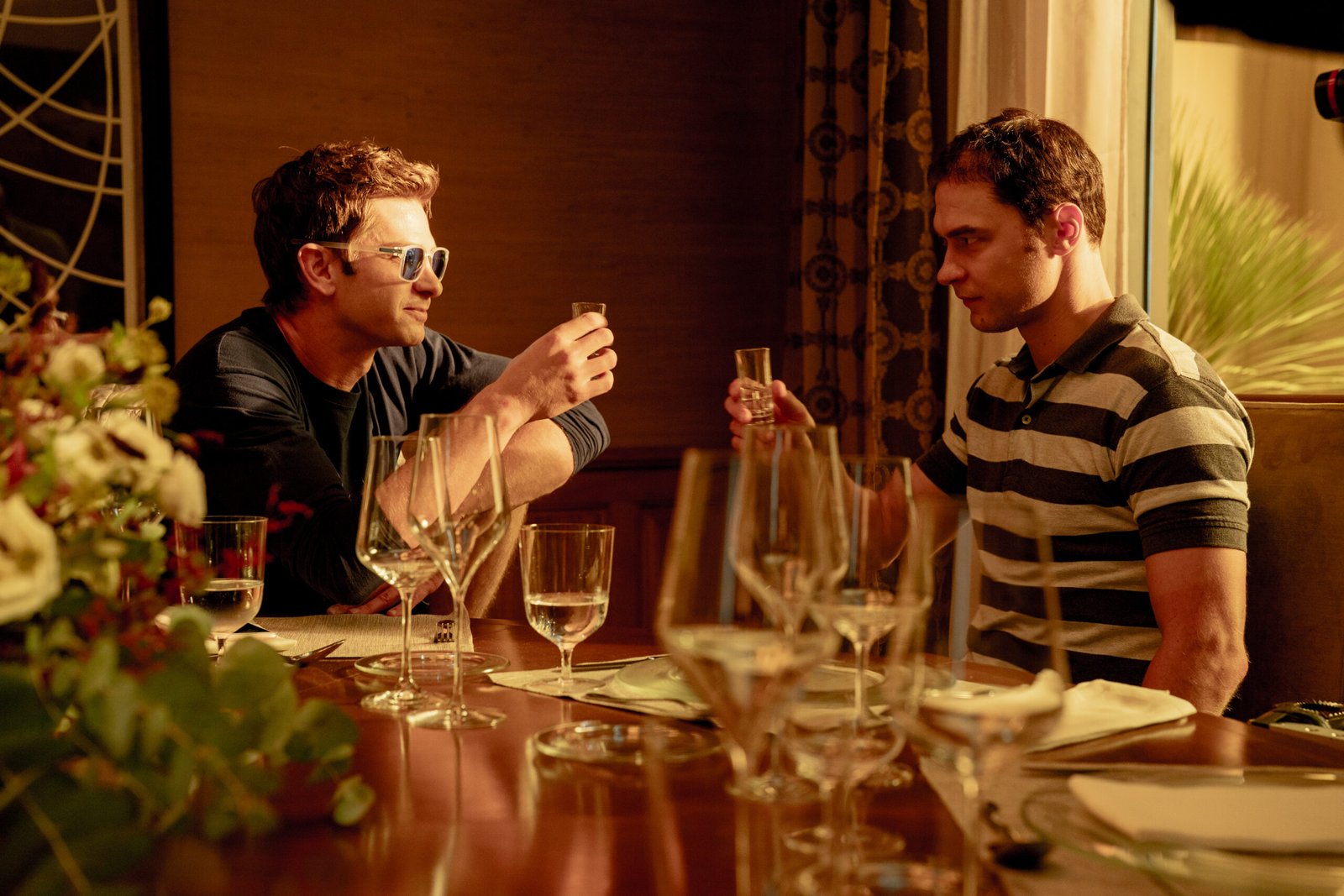
When Ilia first meets Altman, there’s not even the faintest clang of an alarm bell. At that point, Altman, as portrayed by Garfield, is just a skinny, eccentric and possibly vaguely charming guy who’d just happened to make a pile of dough off a tech startup he’d founded, which he later parlayed into various lucrative investments. With Musk and others, he’d already started OpenAI, a nonprofit at the time, with the intent of keeping the development of AI technology in the hands of the people. It’s 2015, and he invites Ilya to a private event in Menlo Park called, somewhat ominously, A Dinner for the Future. The dinner is really just a noisy roundtable of badly dressed tech whizzes drinking shots and shoveling expensive food into their gobs. But somehow, in the midst of all this frat-boy revelry, Ilya is able to outline his vision for the future, one in which AI will have solved numerous human problems, including eradicating not only cancer but also loneliness and unhappiness. By now we can see that Altman, the man presiding over the table, is a wily, evil elf. Somehow, though, Ilya trusts him and leaves Hinton and Google for OpenAI, and the chain of sterling intentions that he’s taken such care in forging begins to tarnish.
Artificial is a story of unchained ambitions and betrayals, with its Altman an unqualified villain. Guadagnino, screenwriter Simon Rich, and Garfield have fashioned him as a pure sociopath, a conniving agent of chaos with Mr. Spock eyebrows and dark eyes that glint like a serpent’s. As Garfield plays him, Altman makes a practice of manipulating those around him for his own ends, though he’ll also run to his boyfriend, mewling with self-pity, when he feels he’s been wronged. (Guadagnino seems to have no compunction about fashioning Altman as an “evil gay”; sometimes you’ve just got to call it as you see it.) Garfield’s performance is both hilarious and truly unsettling. His Altman—sucking down his green smoothies, pouting when things don’t go his way, visiting his neon-lit Napa Valley bunker filled with automatic weapons—is a big baby man who, along with a small handful of others, holds the fate of humanity in his hands. This is the way the world ends, not with a bang but a tech bro.
Artificial features a large, sprawling cast, including Cooper Hoffman as one of Altman’s original OpenAI cronies, and an underused Monica Barbaro as Mira Murati, the Tesla product manager who became one of OpenAI’s key players. But Borisov is the movie’s key. The Ilya of Artificial is a fumbling genius who, unlike his tech compatriots, pads around in sandals instead of big, ungainly sneakers, who sits down at the keyboard when he’s feeling tense, who stumbles with shyness when he’s first confronted with Murati’s brains and beauty. Borisov, who broke through as a thug with a poet’s soul in the 2024 Anora, vests Ilya with the same spiritual contours. You could argue that Artificial is a movie of stark bad guys and good ones, with no middle ground. But maybe, here, there is no middle ground. Ilya’s principled belief in the ways AI might have been used to help mankind is the sort of thing to which you can’t attach a price tag. You can’t say the same about ChatGPT which, as the movie tells it, was rushed to market before anyone had bothered to check its tendency to “hallucinate,” let alone furnish users with dangerous or harmful information.
If Artificial is a movie you think you have no interest in seeing, think again—if only because the people developing, and profiting off, AI technology will surely hope you won’t see it. Guadagnino developed the movie at Amazon MGM, which ultimately declined to release it, not least because Amazon had already announced its own multi-billion-dollar investment in OpenAI. (The film will now be distributed by Neon.)
But it’s important to know that you needn’t approach Artificial with feelings of dread. What makes the movie distinctive is how enjoyably watchable it is. Shot by Malik Hassan Sayeed, it has a vital, vibrant look; its vibe is more teen comedy than Important Picture of Our Time. This isn’t an exceedingly noble, dutifully made picture like Aaron Sorkin’s The Social Reckoning, in which another Anora alum, Mikey Madison, plays a Facebook employee who blows the whistle on that company’s eagerness to court extremist groups as a way of driving up engagement. The Social Reckoning is hardly a terrible film, but it doesn’t have the verve and energy that Artificial does. Guadagnino has made an exhilarating movie that’s also ultimately despairing: Though he’s done a great job of laying out the story of how we got here, he can’t even pretend there’s an easy solution. Yet Artificial doesn’t come off as a helpless shrug. It’s too muscular a piece of filmmaking for that. If we really are being led to our doom by a small handful of greedy, power-mad players, let’s not go down without a fight. Let’s be like Ilya at the keyboard, picking out a tune even in a moment of duress. In the face of an almost incomprehensibly inhuman threat, being the ultimate human is the only answer, from our first breath to our last.