by: Connor Greene | Time.com
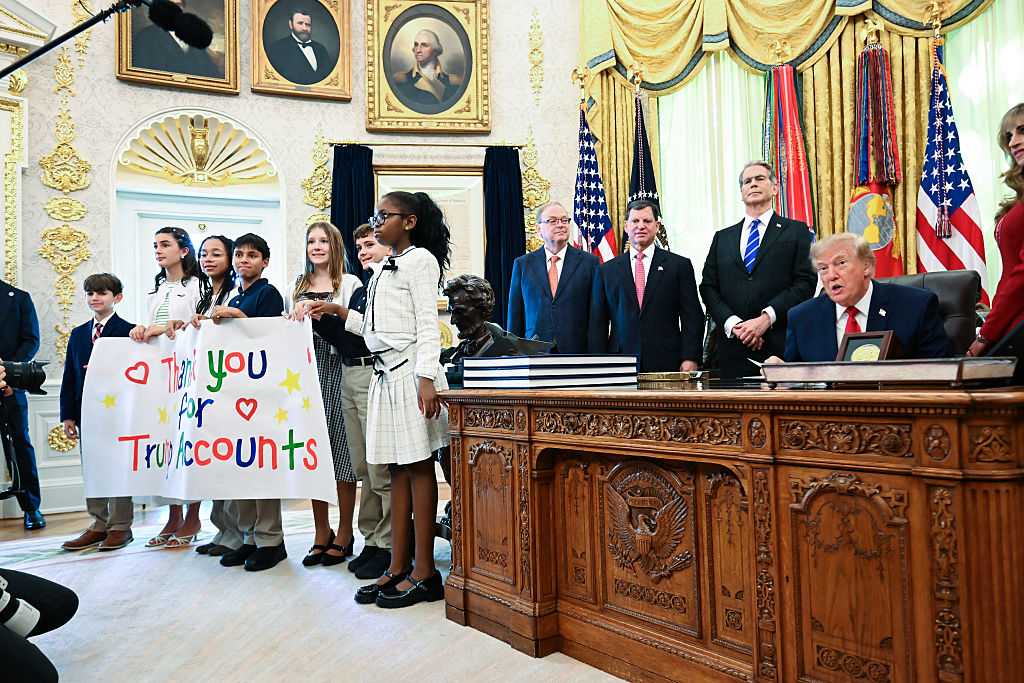
Sixty million American children were automatically enrolled into “Trump Accounts” on Oct. 1, President Donald Trump announced.
Roughly 10 million of the investment accounts for kids have also been created by parents or guardians following the program’s launch on July 4, meaning that the automatic enrollments bring the total number of enrollees to 70 million. That figure represents every American child under 18 with a Social Security number, according to the White House.
“Today we celebrate our next historic … step to ensure every American child has a fair shot at the American dream,” Trump said Wednesday in the Oval Office. “The U.S. government is automatically creating a tax-free investment account for every child to grow over the course of their lives and to be used to their benefit and for their benefit after they turn 18.”
More than $4.5 billion has been deposited into Trump Accounts since they went live this summer, including $1.3 billion in federal seed money, $2.6 billion in philanthropic donations, and over $600 million from family and friends of account owners, according to the White House, which added in a press release that there is “more on the way.”
Here’s what to know about Trump Accounts following the latest announcement.
Trump Accounts are special tax-deferred investment accounts for American children under the age of 18.
Accounts for newborns and many young children will receive seed deposits from the federal government or philanthropists Michael and Susan Dell, with amounts depending on their birth year and zip code. Parents, friends, family, or others also have the option of contributing up to $5,000 per child into the accounts each year.
Money in the Trump Accounts will be invested in a fund that tracks the performance of the S&P 500 Index, which includes roughly 500 of the largest publicly traded U.S. companies.
The funds can only be accessed after a child turns 18, at which point their account will become a traditional Individual Retirement Arrangement (IRA) account. While the accounts will be under children’s names, they will be managed by parents or guardians until the owners turn 18.
The accounts, established under Trump’s “One Big Beautiful Bill,” are intended to help build long-term wealth for American children.
“Our studies found that when a child has an account like this, they are way more likely to graduate from high school, to go into college and graduate to buy a home, to not be incarcerated, to be a contributing member of society, and it improves the mental health of both the child and the parent, even with a relatively small sum,” Michael Dell said during an event in Washington, D.C., earlier this year.
Madeline Brown, a senior associate at the public policy think-tank the Urban Institute, tells TIME that the “infrastructure” created by the Trump Accounts “provides lots of opportunity.”
She argues, however, that the program does not adequately address wealth gaps in the U.S. and should give more money to lower-income families, rather than distributing the same amounts to various groups.
“There’s no essentially guaranteed other money for lower income kids,” she says. “In a structure that was aiming to reduce inequality, you would see additional annual contributions for lowest income kids, ideally from the federal government.”
Who’s eligible to get a Trump Account, and to receive seed deposits?
All American children who are under the age of 18 and have a valid Social Security number are eligible for a Trump Account. With the automatic enrollments announced by Trump on Wednesday, the White House says every eligible child in the U.S. should now have an account.
Certain kids are also eligible to receive funds in their Trump Accounts from the federal government or Michael and Susan Dell.
Once accounts are opened for children born between Jan. 1, 2025, and Dec. 31, 2028, they will automatically be seeded with a one-time, tax-free government payment of $1,000.
Due to an additional $6.25 billion investment from the philanthropists Michael and Susan Dell, children born from 2016 through 2024 who live in zip codes where the median family income is at or below $118,000 will also receive a $250 deposit into their Trump Accounts once they’re activated. Children living on military bases also qualify for the deposits.
An analysis of Census Bureau data by Investopedia showed that roughly 71% of children under 10 will qualify for the $250 deposit. That is expected to amount to about 25 million children, on top of those who receive the seed money from the government.
“We’ve seen what happens when a child gets even a small financial head start, their world expands,” Michael Dell, who was with Trump in the Oval Office on Wednesday, said in a video statement.
How can you claim your child’s account?
To claim a child’s account, their parents or guardians must go to TrumpAccounts.gov to download the official Trump Accounts app. There, they must verify their identity and relationship to their child before claiming the account.
This process is still required to claim accounts for children who have been automatically enrolled in the program.
“Eligible children must also have their Trump Account claimed to receive the one-time $1,000 seed contribution from Treasury,” the Treasury Department wrote in a release on Oct. 1.
How will enrollment in Trump Accounts work moving forward?
In a notice published in the Federal Register, the Treasury Department estimated that an additional two million accounts would be created for children every year moving forward as a result of the auto-enrollment system.
“An eligible individual should not lose the opportunity to receive contributions or investment growth merely because no adult completed an election,” the Treasury wrote in the notice.
Brown says that “reducing friction” in the enrollment process is important. She called the automatic enrollments a “step in the right direction.”
But she stressed that many people are not aware that they have access to the accounts. One study produced by Brown and her colleagues at the Urban Institute showed that lower income families were less aware of Trump Accounts, aligns with research demonstrating how financially secure individuals and households are often more knowledgeable about financial products and opportunities.
“We just need to continue emphasis on education and outreach, including in different languages with trusted messengers,” Brown says.