
Tag: Ukraine

  • Drones sink ships near NATO countries in “unacceptable” attacks, EU says

    Drones sink ships near NATO countries in “unacceptable” attacks, EU says

    by: Jeremy Hsu | Ars Technica

    Drones sank two cargo ships and damaged a third in the exclusive economic zones of NATO member countries for the first time, killing at least two sailors. The attacks represent a notable escalation as Black Sea commercial shipping has increasingly come under attack during the Russian invasion of Ukraine, with Russia also being accused of carrying out “hybrid warfare” incidents across Europe.

    The Togo-flagged cargo ship Alfa Watan sank, and the Palau-flagged cargo ship Able was set ablaze after being attacked by multiple sea and aerial drones about 80 miles (128 kilometers) off the coast of Bulgaria on October 6, according to the Associated Press. In an interview, Bulgarian Prime Minister Rumen Radev described the incidents as “an unacceptable attack in Bulgaria’s exclusive economic zone” and “a blatant violation of international law and maritime law.”

    The fate of the Alfa Watan’s crew was not immediately known after the vessel sank. A Bulgarian ferry managed to evacuate the 18 crew members of the Able, with two severely injured mariners being flown to a hospital in the city of Varna.

    This comes one day after drones struck the Turkish-owned cargo ship named Royad Mammadov within Romania’s exclusive economic zone in the Black Sea on October 5. That ship caught fire and eventually sank, with 11 crew members rescued by Romanian ships and helicopters while one crew member remains missing, according to Euronews. Two crew members were killed.

    European Union president Ursula von der Leyen described the drone strikes on the three vessels in the Black Sea as “increasingly concerning” in a post on X. But she also cautioned that the circumstances of the attacks are “still being established” without naming a probable attacker.

    “Attacks on civilian shipping are unacceptable,” Leyen wrote. “We stand in full solidarity with our Member States on the Eastern flank.”

    By contrast, Ukrainian President Volodymyr Zelenskyy described a joint investigation with Bulgaria’s navy as finding that the latest strikes represented a “Russian combined attack using both sea and aerial drones,” Reuters reported. Zelenskyy also said that Ukraine’s military was not conducting operations in that part of the Black Sea.

  • Russian drones strike Ukraine’s data centers by exploiting air defense gaps

    Russian drones strike Ukraine’s data centers by exploiting air defense gaps

    by: Jeremy Hsu | Ars Technica

    A surge in Russian jet-powered drone strikes on Ukrainian data centers has increasingly disrupted mobile phone and Internet services for thousands of people. Now Ukraine President Volodymyr Zelenskyy and other government officials are warning of the need for more air defense capabilities, as such telecommunication outages could threaten Ukraine’s digital economy and undermine the country’s ongoing resistance to Russia’s invasion.

    The Russian attacks on Ukrainian telecommunication infrastructure have focused on Ukraine’s capital of Kyiv since September 23, according to the nonprofit Reporters Without Borders. Ukraine’s digital transformation ministry reported that 100,000 households in the Kyiv region were temporarily experiencing Internet outages from those initial strikes—and Russia has only intensified its strike campaign against major Ukrainian data centers and mobile phone networks in recent weeks.

    “Russian attacks on Ukraine’s telecommunication infrastructure are not new, with strikes and shelling previously damaging fiber optic lines, cell towers, and facilities belonging to mobile network companies,” said Tetiana Gaviuk, analyst for Europe at ACLED, in a post on October 1. “However, the recent concentrated attacks on Kyiv’s data centers and telecom networks stand out because multiple providers and facilities were hit within days, indicating Russia’s increased pressure on Ukraine’s digital infrastructure.”

    Such repeated attacks could undermine the telecommunication networks that support Ukraine’s banks, payment systems, and public services, according to warnings from officials and industry figures, as reported by The Guardian.

    Russia’s strike campaign

    Russia has launched mass missile and drone attacks on Ukraine’s power grid infrastructure, railroad stations, shipping ports, and even residential apartment buildings since the first year of its full-scale invasion in 2022. But such long-range strikes have become even more damaging this year, as they have exhausted Ukraine’s supply of missile interceptors—and Russia has also upgraded many of its one-way attack drones to become faster jet-powered drones that are more difficult to shoot down.

    For example, Zelenskyy stated on October 4 that Ukrainian air defenses currently intercept more than 85 percent of conventional Shahed-type drones originally developed by Iran and supplied to Russia. But such interception rates fall to just 50 or 60 percent when dealing with newer and faster jet-powered Shahed drones.

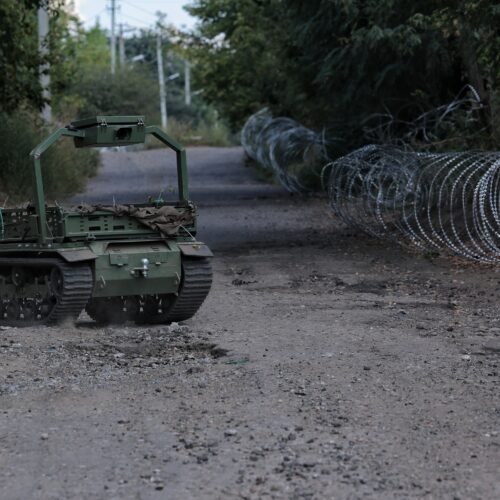
  • Robots make combat airdrops, clear mines as Ukraine defeats Russian pincer

    Robots make combat airdrops, clear mines as Ukraine defeats Russian pincer

    by: Jeremy Hsu | Ars Technica

    The latest battlefield uses of such robots have helped the Ukrainian military’s Operation Vivald reclaim up to 96 square miles of territory. Operation Vivaldi has also defeated Russian forces that were the northern part of a pincer movement attempting to encircle Ukraine’s “Fortress Belt” cities in eastern Ukraine, according to the Institute for the Study of War (ISW), a think bank based in Washington, DC.

    Vivaldi’s success and the fall season

    Since launching in May 2026, the Ukrainian Third Army Corps operation has practiced strict operational security that has kept successful advances under wraps for a long time. That has helped mislead Russian leaders, whose operational awareness is also hindered by what the ISW described as a “pervasive culture of lying within the Russian military” about the real battlefield situation when things aren’t going well for Russia.

    Operation Vivaldi’s success has also been enabled by Ukraine’s intermediate-range drone strike campaign targeting Russian fuel supplies, which has reduced the availability of diesel fuel for generators powering Russian electronic warfare systems. At the same time, Ukraine’s own electronic warfare systems reportedly neutralized about 20,000 Russian drones.

    Together, such factors have helped Ukraine achieve “tactical drone overmatch” while supporting Ukrainian mechanized advances toward Lyman in Ukraine’s Donetsk Oblast, according to the ISW assessment. Members of Russia’s elite drone unit, called Rubicon, were withdrawn from the region after the Ukrainian Third Army Corps inflicted losses on the Russian drone pilots and the unit’s resources, according to The Kyiv Independent.

    But the Russian military is still directing armored vehicles and drone units such as Rubicon toward Dobropillya in the Donetsk Oblast in preparation for future mechanized assaults this autumn. During the summer, the Russian military tested a new anti-drone protection system for its most modern tanks that saw limited success—although Ukrainian drones still overwhelmed the tanks’ defenses.

    The Russian military has also adapted many of the same drone warfare innovations used by Ukraine while sometimes developing its own as it continues attacking Ukrainian cities with missiles and drones. Russia has also stepped up a campaign of “hybrid warfare” against Europe, with recent examples including an explosive drone boat turning up near a vital offshore gas site and an attempt to attack parked Ukrainian cargo aircraft with a drone at Leipzig Airport in Germany.