by: Ildar Farkhatdinov, The Conversation | Ars Technica
One of the earliest known concepts was patented in 1890 by Nicholas Yagn, a self-taught Russian inventor, who designed a wearable apparatus for exercising. And in 1919, the American Leslie C. Kelley received a patent for a steam-powered device to support walking, one of the first powered exoskeleton concepts.
By the end of the 1960s, multiple actuated robotic exoskeletons incorporating electronic control systems had been developed. Since then, exoskeleton research and development has advanced rapidly, leading to the emergence of numerous devices with commercial and clinical applications.
How they work
Exoskeletons generate forces to make the wearer stronger, move faster, or fatigue slower.
Some devices also improve movement accuracy and dexterity or support overall posture. Some are designed to elevate human capabilities beyond what is typically possible. Others help patients with reduced physical capacity.
Modern, active robotic exoskeletons typically consist of a lightweight mechanical frame with ergonomic attachments to the human body. These are usually affixed at the trunk, waist and to upper or lower limbs.
For example, the Hypershell device seen in Ukraine attaches to the user’s waist and thighs, to assist with hip flexion and extension and strengthen lower-body movement. The SuitX device used by IKEA attaches to the torso and upper limbs, to support the back and shoulders.
In most powered exoskeletons, mechanical components called actuators convert electric power from batteries into mechanical movement, generating forces that support or enhance the body’s movement.
The actuators are coordinated by control units embedded in the exoskeleton. These define the trajectories of the exoskeleton’s movements and how much force it applies to the wearer’s body. Exactly how the device moves, and how forcefully, will depend on the task and the state of the user—with the device using sensors to determine what’s needed.
For instance, if a wearer starts running, an exoskeleton will speed up its supportive movements. If it senses they’re beginning to fatigue, it might increase its power output to compensate.
With Paramount CEO David Ellison overcoming the final hurdle blocking his expansion of the Paramount media empire, the billionaire media executive announced on X (formerly Twitter) that the newly merged entity combining Paramount and Warner Bros. Discovery will be named Skydance.
The announcement comes after the company entered into a consent decree to settle antitrust claims brought by a group of 12 state attorneys general, who had sued in July over concerns that the merger would concentrate too much control over news networks, cable TV and the film industry. With the last legal opposition cleared, the path was open to finalize the massive the $111 billion merger on Sept. 21.
“Together, we are Skydance: a creative-first home for bold, quality storytelling,” Ellison posted on Friday. “We wanted a name that would give the combined company an identity of its own while allowing Paramount and Warner Bros. — and all our extraordinary brands — to remain in the spotlight.”
There was a year-long bidding battle for Warner Bros. Discovery, leaving Ellison as the top bidder after Netflix dropped out. The name Skydance comes from Ellison’s love of aviation and aerobatic “skydancing.” David’s father is Larry Ellison, who is co-founder and chief technology officer of Oracle and one of the richest people in the world.
What once was the peak, is now just the beginning.
Paramount and Warner Bros. shaped over a century of culture. By combining them, we aren’t rewriting history — we’re equipping these iconic studios with a more powerful engine. Together, we are Skydance: a creative-first home for… pic.twitter.com/uInLRY3IrE
A Hollywood empire of studios, news, networks and streamers
As viewers, it’s unclear how streaming content from Warner Bros., HBO and Paramount via apps like HBO Max and Paramount Plus will change. But the merger will undeniably affect employees at the mega media company, now one of the largest in history. Much of the legal opposition concerned their fate, and the consent decree attempted to safeguard employment, film production and distribution and consumer pricing.
In practice, employees usually lose out in corporate consolidation, regardless of protections. Harvard Business Review estimated that up to 30% of workers get laid off in mergers like these, where there’s a significant overlap in the business, though that oft-cited figure is from 2017.
The bigger worry, though, is media monopoly. Critics worry that adding CNN to the company’s portfolio could lead to widespread restructuring and corporate upheaval, similar to recent struggles at the CBS News division. Corporate convergence also risks homogenizing news content by potentially suppressing divergent viewpoints — all for minimal reward, given that CBS’s own ratings are reportedly way down.
“If this trend of consolidation continues, we will be left searching dominant media outlets in vain for news and information that challenges the powerful and stands up for people who are struggling to pay monthly bills, put food on the table and engage in local civic life,” nonprofit watchdog Free Press co-CEO Jessica J. González said in a prepared statement earlier this week.
The Block the Merger coalition also posted a follow-up statement: “Allowing the Paramount Skydance-Warner Bros. Discovery merger to move forward with no meaningful structural remedies will cost jobs, mute creativity, weaken independent journalism, and damage our First Amendment rights. The ripples of this merger will be far-reaching, long-lasting, and impossible to contain.”
The Writers Guild of America East and Writers Guild of America West had filed a separate lawsuit to halt the merger, alleging that it was illegal and would harm writers. Once the state attorneys general backed out of the battle, WGA cited an inability to sustain legal costs on its own and dropped its companion lawsuit.
As part of the consent decree, Paramount agreed to establish an oversight board of journalists to protect the editorial independence of CNN and CBS News. Critics have called the oversight board “toothless,” noting that its members are appointed and paid by the company, that its authority is unclear and unbinding, and that final control rests with Ellison.
We reached out to Skydance for comment and didn’t immediately hear back.
Disclosure: Lori Grunin has stock in Paramount from when CNET was owned by CBS.
Lori Grunin
Senior Editor / Computers and Gaming Hardware
I’ve been reviewing hardware and software, devising testing methodology and handing out buying advice for more than 25 years. See full bio
Bonus: Every Electric’s batteries are beloved by household cats.
My family has spent four summers participating in demand response programs whereby utility companies pay customers to reduce energy use on the hottest summer days. Most summers have involved carefully precooling our New York City apartment before switching off the air conditioners and sweating it out during the designated demand response periods.
But this year, we kept our window air conditioners running throughout a heat dome event that drove daytime temperatures into the triple digits and made the nights oppressively hot. The difference was that we powered the air conditioners through two household batteries tucked away unobtrusively in the corners of our living room and bedroom.
We were among about 1,000 New York City households that took part in a free and growing program offered by the local startup Every Electric. The company’s proposition is simple: Get one or more batteries delivered to your home, plug the batteries into a standard wall electrical outlet, and then plug your window air conditioners into the batteries. Households can keep running air conditioners as usual during peak demand periods while also earning money through the local demand response program with the utility company Con Edison.
“Being able to make air conditioners drop off the grid without actually impacting the comfort of residents was really awesome to see,” said Andrew Wang, co-founder and CEO of Every Electric, in an interview with Ars.
Wang and cofounder Richard May first met while working together as postdoctoral researchers at the Columbia Electrochemical Energy Center at Columbia University in New York City. In 2023, they launched the startup under the name Standard Potential Co., with a focus on developing sodium-ion battery chemistry for commercialization.
But they soon pivoted to a very different business plan—deploying residential batteries across New York City households to create a network of energy storage resources acting as a virtual power plant. The company officially rebranded as Every Electric in 2026.
Getting set up
Many companies have established virtual power plant programs to offer utility companies greater flexibility and resources for managing electricity demand on the grid. Every Electric stands out for piloting a free power bank program that loans batteries to apartment renters and other households in exchange for a temporary deposit, which the company has reduced from $50 to $30 per battery.
The deposit is returned when a household decides to send the batteries back. Customers can also purchase the batteries outright for $650 each.
The battery delivery and setup process is straightforward. When the drop-shipped batteries arrived in their boxes, I plugged them into the appropriate wall sockets and followed a simple process to register the battery serial numbers with Every Electric and connect the batteries to my home Wi-Fi network.
Once connected to a local household’s Wi-Fi, the batteries act as power banks that automatically charge during low-demand periods at night and discharge their energy storage when air conditioners are running during peak demand periods. Every Electric automatically manages the battery cycles remotely.
Customers eventually get paid through Every Electric online accounts linked with Con Edison’s Smart Usage Rewards program. Every Electric gets paid directly by Con Edison as a program partner and, in turn, generally promises residents can earn $150 each year per air conditioner.
“There’s a business model innovation here where you make [household batteries] as easy and as accessible as possible, you get them as far and wide as possible, and then you essentially share in the value that you provide in the grid,” Wang told Ars. “We split the earnings so that households can see tangible benefits, and then we pay off the assets and grow the program as it goes along.”
Using the battery
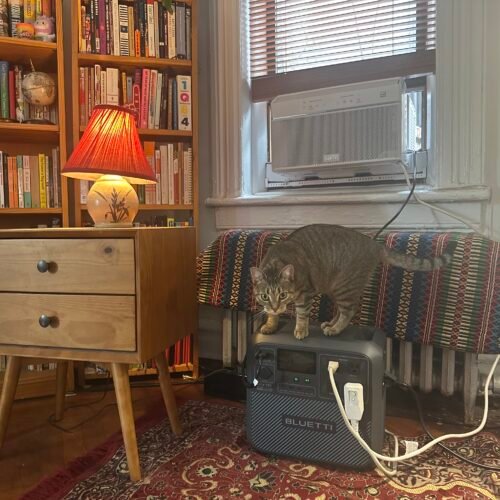
Every Electric’s battery of choice is the Bluetti Elite 200 V2, a lithium iron phosphate battery that can store 2 kilowatt-hours of energy while being compact enough for smaller New York apartments. It’s compatible with any 120V plug-in air conditioner, but it has four standard AC sockets that can also accommodate other appliances such as plug-in fans or air purifiers.
Additional battery sockets can charge laptops, smartphones, and other electronic devices that have power cables using USB-A or USB-C connectors. A 12V DC outlet in the style of a car’s cigarette lighter is also available.
The batteries can even provide backup power during power outages. For example, households can plug their Wi-Fi routers or refrigerators into the batteries to keep those devices running.
One bonus has been the discovery that feline family members of various New York households especially enjoy hanging around the batteries. “We found out cats are big fans of the powerbanks,” Wang told Ars. “I think it’s because they’re a little warmer.”
Despite such upsides, there have been a few kinks to work out during peak demand periods. When the utility company Con Edison had to reduce voltage for hundreds of thousands of customers across New York City to protect grid equipment during extreme heat periods, the power draw from the batteries tripped my apartment unit’s circuit breaker on two separate occasions.
Every Electric’s team responded by continually updating the battery firmware to reduce the risk of tripping local circuit breakers. That challenge can vary depending on each customer’s building.
“Every household is unique, and sometimes you have pre-war buildings with old wiring,” Wang told Ars. “You have to manage both some of the losses that are on the ConEd side and then some of the losses that might be in the wiring in people’s walls to finetune how we operate the power banks to fit within the parameters of each household.”
From dozens to thousands of batteries
The company initially deployed 100 batteries across 65 households in the first test run in the summer of 2025. This year, it scaled up deployment to 2,000 batteries across about 1,000 households, providing the total equivalent of four megawatt-hours of energy storage during the summer of 2026.
“If you picture one of the big utility-scale, containerized batteries, one of those blocks is usually four megawatt-hours,” Wang explained. “So we’ve sort of taken that up and broken it up into 1,000 pieces spread across the city.”
This approach opens the door for distributing residential batteries to many more households by making inroads into the largest US city with more than 2 million rental homes. And more than 80 percent of New York City housing was built more than 50 years ago, meaning that they typically rely on window air conditioners without central air conditioning.
But not every initial customer has been an apartment dweller—early adopters also include residents of single-family homes in the New York City boroughs of Queens and Brooklyn. Some residents have even paired the batteries with plug-in solar panels to make the most of combining household energy storage with renewable power.
Whatever the home configuration, Every Electric’s program has proven popular in its first two years. The wait list grew to requests for more than 15,000 batteries this past summer—and Every Electric is aiming to scale up to more than 10,000 deployed batteries in 2027.
Every Electric remains focused on New York City as its home court. But as the battery network grows, the startup is also exploring new ways for Con Edison and other utility companies to get value from the distributed energy storage system beyond just participating in the demand response program.
“We have new utility territories that are coming to us—they’re seeing that you can drop-ship literal megawatt hours to customers as a solution,” Wang said. “So we’re certainly looking at how to map this model onto new markets.”
Jeremy Hsu is a reporter exploring a wide range of topics across deep tech and AI. He has previously written for New Scientist, Scientific American, IEEE Spectrum, Wired, Undark Magazine and MIT Tech Review, among many other publications, about topics such as deepfakes, data centers, drones, battery tech, robotics, and GPS jamming. He also has a Master of Arts in Journalism from NYU, and a bachelor’s degree from University of Pennsylvania in History and Sociology of Science, with a minor in English.