by: Callum Sutherland and Olivia-Anne Cleary | Time.com
French students took to the streets again Thursday and blockaded some high schools as they demanded action from the government they say is underfunding the country’s education system. Now in its third week, the wave of protests has seen hundreds of thousands march after rows over staffing shortages, overcrowded classrooms, and dilapidated buildings reached a crisis point.
The protest movement went nationwide on Tuesday, after student unions called for a wider support of their mobilization, with parents, teachers, and activists heeding the call. Some protests have turned violent, with attendees lighting fires and hurling projectiles, and police using tear gas and water cannons. Since the protests began, at least 6,547 people have been arrested or stopped by police, said France’s Interior Ministry. Hundreds of students and police officers have been injured. The French Education Ministry told TIME that as of midday Thursday, local time, 157 schools remain closed.
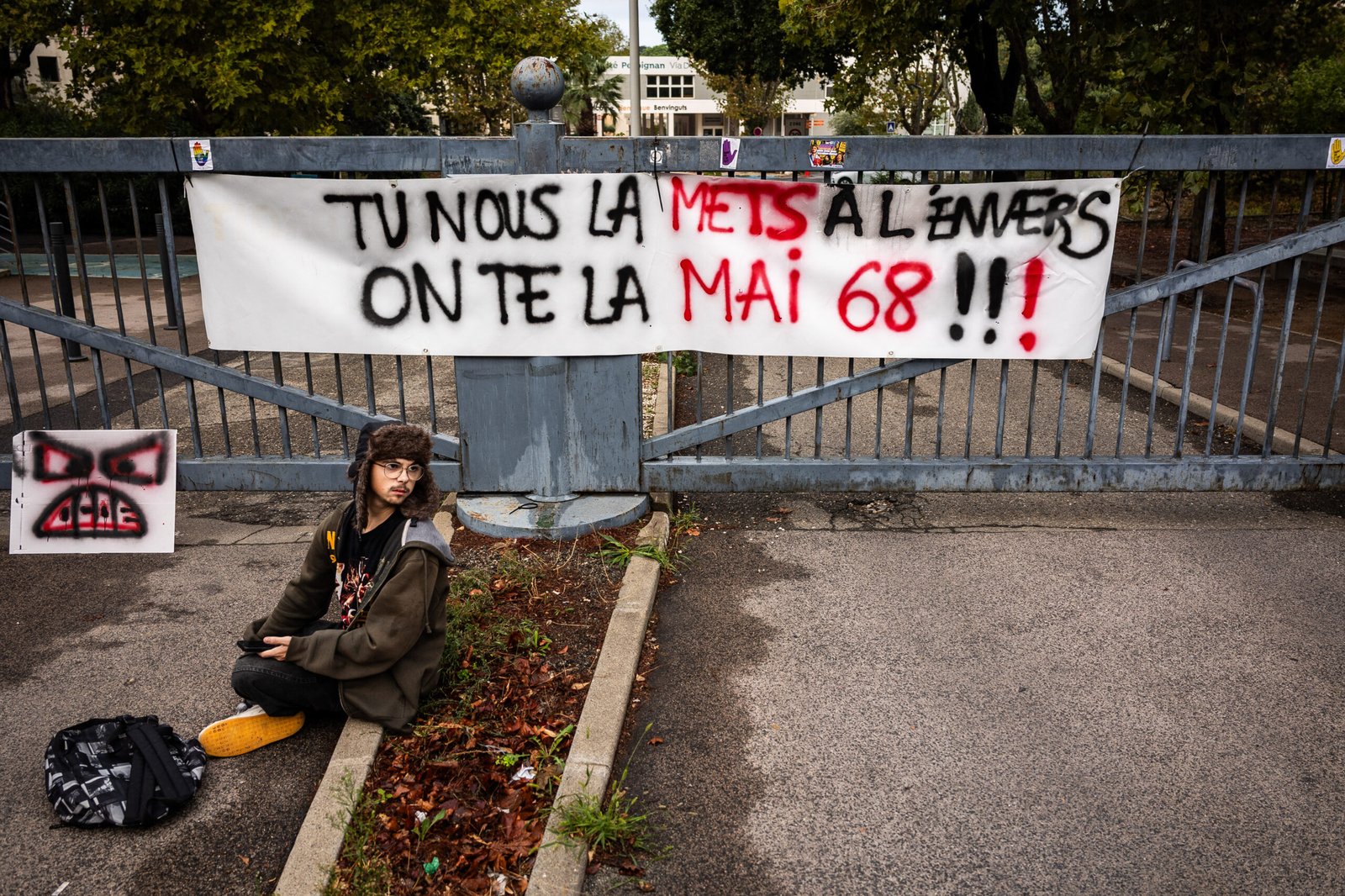
Throughout the protests, students and other attendees have held up various signs calling for change. A common theme has emerged, as many of the homemade banners mention the year 1968—and more specifically, May 1968. That’s in reference to the nationwide protests initiated by a student movement in 1968 that led to millions of workers striking and nearly toppled the government.
During the blockade of the University of Perpignan Via Domitia on Tuesday, a banner raised on the gates contained a warning, which roughly translated to “You’re trying to pull a fast one on us, we’ll give you May ’68.” Elsewhere, as students gathered in Reforme Square in Marseille, a protester held a sign that read “Generation 67 is doing May 68,” thought to be in reference to the Gen Alpha 6-7 trend. In Paris, someone held a black and white sign of a larger figure with their hand over the mouth of a youngster, emblazoned with the phrase “sois jeune et tais-toi,” which means “be young and shut up.” That same slogan was used during the 1968 protests.
“1968 was a seminal moment in the protest history of France,” says Chris Reynolds, professor of contemporary European history at Nottingham Trent University. “Not only because of the sheer enormity of what happened, but that it started out as a smallish student protest that within a very short space of time mushroomed to become arguably the greatest strike in French history.”
What happened in 1968 is anything but a distant memory, experts tell TIME. Not only do the youth of France draw inspiration from the rallying of a generation, lawmakers are also mindful of how powerful such protests can be.
“Ever since 1968, there has been a fear within the state that it could happen again,” says Reynolds. “This idea that somehow the students could be the starting point of a movement that would then elicit support from other sectors of society, leading to a much greater crisis.”
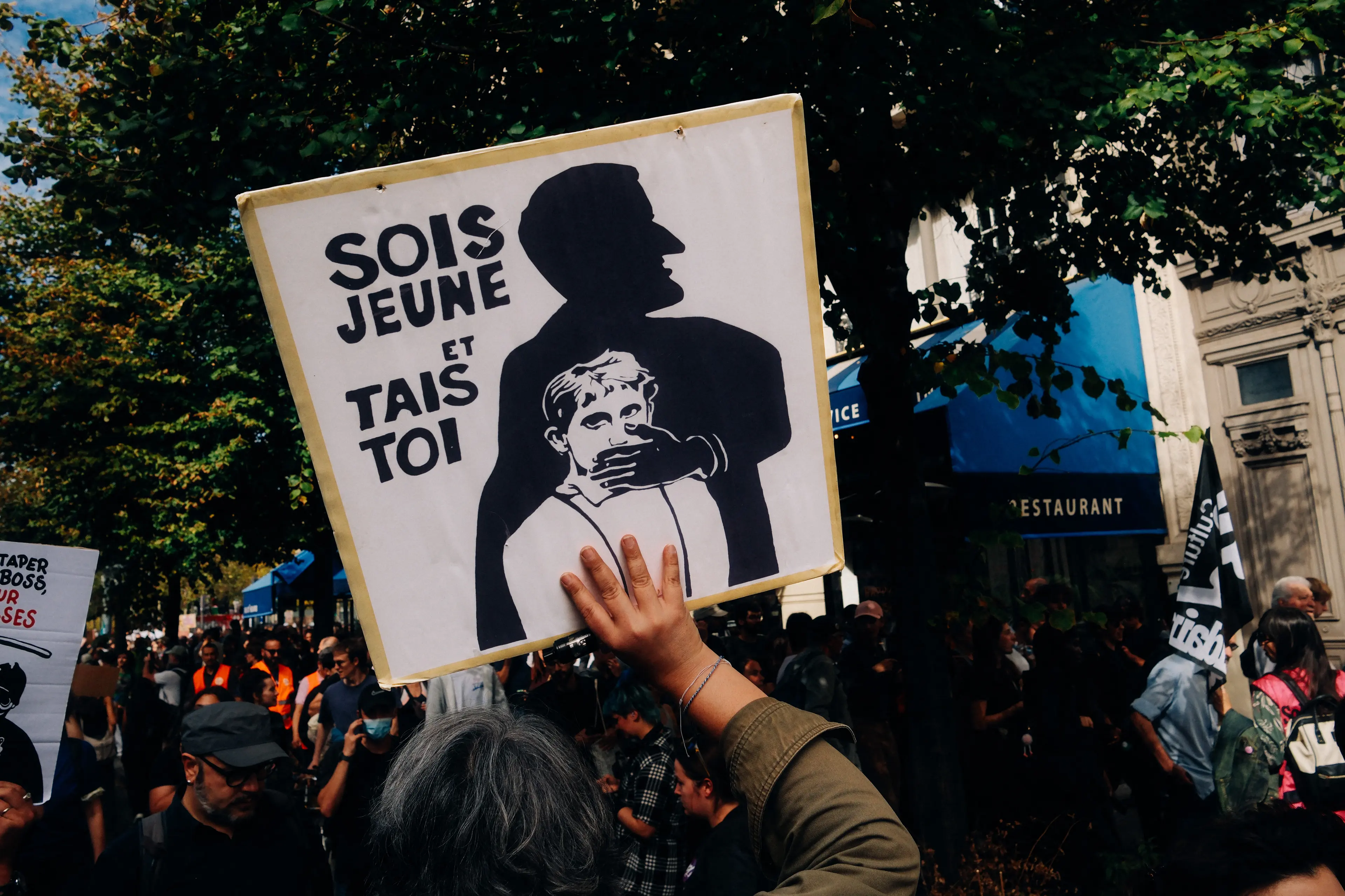
A protester holds a placard with a slogan that translates to “Be young and shut up” during a march of high school and university students in Paris, France, on Oct. 6, 2026. Laurent Demartini/Hans Lucas—Getty Images
What happened in May 1968?
Students at the Nanterre campus of the University of Paris held protests across 1967 and 1968 in opposition of rules they viewed to be too restrictive and conservative.
“It was a crisis of education. At that point, universities were expanding very quickly in the 1960s,” says Robert Gildea, a professor of European and French history at the University of Oxford.
“Universities then were also very conservative and hierarchical,” he adds, noting that a lack of communication between the faculty and students led to growing frustrations.
One argument centered on restrictions on dormitory visits that stopped male and female students staying in each other’s rooms.
In May 1968, when the Nanterre campus was shut down in an effort to dampen escalating protests, the movement moved to the Sorbonne campus in Paris’ Latin Quarter. Students barricaded themselves within the university grounds and called for a reform of the university system, while accusing French President Charles de Gaulle of running a “police state.” Clashes ensued between riot police and student protesters, hundreds of which were arrested. A particularly violent clash in the early hours of May 11 garnered nationwide attention.
The protest movement expanded when trade unions came on board and organized a series of strikes across the country, demanding better pay and conditions for workers in factories and other industries. At the height of the protests, around 10 million workers went on strike, bringing France to the brink and raising concerns in government about the impact on the economy.
President De Gaulle dissolved parliament and cited a state of emergency. He called a snap election in June, which his conservative party ultimately won as French voters gravitated toward the promise of restored stability. The protest movement lost momentum and withered, but it left a lasting impact.
Gildea says many students now reference 1968 from a place of pride, while also warning a revolution could happen if the youth bands together.
“1968 was the last huge explosion of students and workers, which nearly brought the state down,” he says. “The French are very proud of their revolutionary tradition and all subsequent revolutions want to reference it as an appeal for legitimacy.”
In the years since 1968, French students have often taken to the streets to air their grievances, with notable demonstrations happening in 2006 and 2018—all of which have drawn comparisons to 1968.
“It remains this recurring reference point in French history, which seems to be passed down from generation to generation, without fail,” Reynolds says.